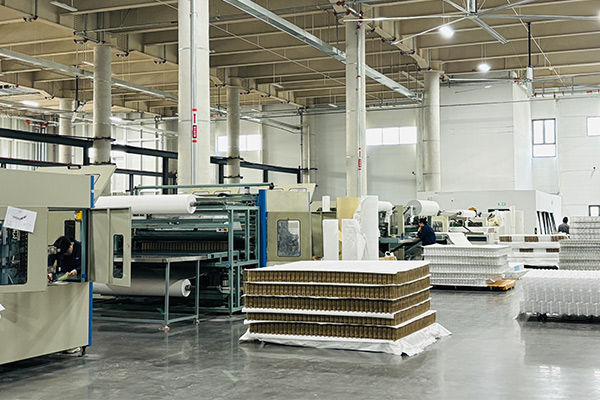
The global mattress industry is undergoing a smart revolution, driven by automatic mattress making machines that redefine efficiency, precision, and flexibility. As demand for personalized sleep solutions grows, these advanced systems have become indispensable for manufacturers aiming to stay competitive in a fast-evolving market.
At the core of their appeal is unparalleled production efficiency. Integrating technologies like servo motor control, AI visual positioning, and modular workflows, these machines reduce labor requirements by up to 80% while boosting output fivefold compared to traditional methods . For example, intelligent lines can handle 300-3000 mattresses daily, covering every process from material cutting and automated gluing to edge stitching and compression packaging . Precision is another hallmark—with positioning accuracy reaching ±0.02mm, they minimize defects, lowering non-conformity rates to below 0.5% .
Customization capabilities stand out as a key advantage. Modern machines adapt seamlessly to different mattress types (spring, memory foam, latex) and sizes through data-driven parameter adjustments . Modular designs also optimize space usage, allowing small factories to deploy compact lines and large enterprises to scale up production without full facility overhauls . Integrated MES and WMS systems enable real-time monitoring, letting manufacturers track production cycles, adjust schedules for urgent orders, and reduce resource waste .
Market growth reflects their transformative impact. The global automatic mattress machine market is projected to reach $82.3 billion by 2025, with a 12.8% CAGR, fueled by demand for flexible, energy-efficient production . Leading manufacturers like Yuantian and NAIGU offer end-to-end solutions, including after-sales support and system upgrades, fostering long-term partnerships with clients .
In essence, automatic mattress making machines are more than production tools—they are catalysts for industry innovation. By combining speed, precision, and adaptability, they empower manufacturers to meet consumer expectations while driving sustainable growth in the global bedding market.